Showing posts with label ISIS. Show all posts

Friday, December 5, 2014

ISIS Group Reflection

ISIS Group Reflection


Through the ISIS blog assignment, my group members and I worked to gain and distribute engaging and informative information about the militant group ISIS. In the short amount of the time that we had, we were able to publish four different blog posts- each detailing different aspects of the organization of ISIS. First, we provided a short timeline and general overview of ISIS, explaining the origins of the militant group and events leading up to the formation of ISIS. Then, we explored the role of women in ISIS. This included explaining the deep social and political inequities between men and women in the extremist ISIS narrative, as well as exploring ISIS’ surprising use of women in combat- as seen in the example of al-Khansaa. We then revealed ISIS’ different sources of income- including robbery, the taxation of hostage communities, the selling of oil, and ransom money. Lastly, we discussed the use of propaganda via social media- including ISIS’ use of public beheadings of Americans as a recruitment tool for Western viewers.


Because of the ever-developing story of ISIS and Islamic extremism in the middle-east, our group relied heavily on breaking stories via the internet. For many reasons, this was an incredible resource and tool for us as we were able to access an array of stories and opinions from different countries and perspectives… but for those same reasons, we sometimes found it challenging to find stories that we felt were completely objective and true. But, I felt that in many ways we solved this issue by presenting the different perspectives that we felt came from reliable and reputable sources. To this same effect, working in a group setting helped our blog achieve a higher level objectivity and a broader sense of perspective. I felt that this was a result of the natural cross examination of sources and information that must happened when working in a group setting (as opposed to gathering information and writing the blog yourself).


From this blog project, I feel that I have become a better group member, that I have learned more about ISIS and it’s influence on middle eastern and international politics, and that I have learned/formed the habit of active and thorough research with scrutiny, especially when dealing with breaking news from faraway places. I felt that I became a better group members because this specific blog project require both independent research, as well as out-of-class group work- keeping each of us accountable for both the research and execution of every post. I felt that I learned a lot about ISIS and it’s influence in the middle east through my time investment in the issue through this assignment- whether it were for a specific post or not. Lastly, through research and exposure to so many different sources of information and opinion, I felt that I gained a certain level of academic scrutiny when dealing with international politics: learning to question the information I gather and understanding that no news is without bias.

Teamwork!

Sunday, November 23, 2014

ISIS's Triple Threat: Fear, Extortion, and Brainwashing


Propaganda:


Photo taken from "Flames of War" propaganda video
Dramatic music, preaching, executions, and explosions. These are the hallmarks of almost every ISIS propaganda video. One of the most dramatic and shocking videos “Flames of War,” released by ISIS in September, exemplifies these pieces of imagery. There are slow motion explosions from attacks against US forces, images of wounded US troops, and US troops being surrounded by flames that engulf the screen. It’s an all too familiar production, with many similar videos having been made and circulated on the Internet. “Flames of War” looks almost like a movie trailer, especially with the final words across the screen: “coming soon.” It suggests a declaration of war against the United States in a very dramatic way. It can be seen that ISIS wants to send a message with these videos. Perhaps one of an overly romanticized vision of their jihad meant to spread fear and recruit young men who dream of being heroes. Whatever the goal behind these propaganda videos is, the quality of these videos is much better than could usually be expected from a rag-tag extremist group. In fact, when it comes to media propaganda, ISIS is ahead of the game. The high quality, drama, and allure of their videos can be attributed to the Al Ayat Media Center, which is a branch of ISIS dedicated to media propaganda. Just like a Hollywood movie production company, Al Ayat puts together videos to incite emotion in both the men they want to recruit, and the Western enemies they despise.

In seeking to inspire other radical Muslims around the world to join their cause, ISIS has taken to visual media. Surely, the West never thought that a medium that was created in a benign fashion would be used as a recruiting tool with the ultimate goal of countless deaths and an Islamic caliphate. Seeking to appeal to young men specifically, the videos have a strong sense of masculinity in them, almost making it seem as if once they join, they’ll be like the hero in a video game or movie. ISIS is even using Western or, more specifically, Hollywood presentation and style in their propaganda videos to help them recruit people to ultimately wage war on the West. The irony of their slick propaganda is that it promotes a sense of self-actualization and individual significance more in line with their sworn enemy’s philosophy than with an Islamic concept of ummah, or community. It never seemed likely at the outset of the War on Terror that a decade later, radicals would be using media in such a Western way to spread their message of fear and death. ISIS sees the power of video and the power of presentation and they are taking full advantage of both to help carry them towards their vision of how the Middle East should be governed.

A Western Audience:

Pro-ISIS propaganda spreading to the West
While ISIS’ recruiting strategies were initially confined to their immediate area, they have now widened their influence globally. Through savvy social media usage, they have successfully recruited thousands of Europeans and Americans to join their jihad. With the advent of heavy social media usage, ISIS has completely changed the landscape of western recruitment and the Jihadi presence on social media. Videos released by ISIS bear similarities to an entertainment show in the specific camera angles and dialogues. They also have created a media conglomerate in which they release documentaries, news reports, and a magazine called Dabiq. They primarily release all their information in a multitude of languages ranging from Arabic to English to French. This is done in order to reach a larger audience and consequently draw in a bigger group of recruits. Because of the amount of outreach done through technology and social media, ISIS has been successful in the recruitment of youths and recent converts from all over the world.

The implications of ISIS’s targeting of young Muslims in countries like the United Kingdom and the United States are alarming. No longer is the reach of radical Islamism restricted to the existing pool of fighters left over from the Israeli-Palestinian conflict and Soviet-Afghan war; now it extends to Muslims who grew up in secular states that have never been near a warzone, let alone held a weapon. Their savvy use of social media contrasts with the archaic methods of Al-Qaeda; Twitter and Tumblr have replaced fuzzy camcorder recordings of Osama Bin Laden’s monologues. ISIS realizes that sermons are not enough to attract the next generation of jihadis. Instead, ISIS has released a slick media package designed to legitimize ISIS as a state rather than an insurgent group by showing off it’s monopoly on violence within western Iraq and north-eastern Syria. This is a case of success breeding more success: ISIS presents itself as the only serious option for fighters looking to be on the winning side, making more moderate groups like Al-Nusra look weak in comparison. If allowed to spread their propaganda unchecked, ISIS will soon become the default destination for young, disaffected Muslim fighters regardless of how secular or Westernized their backgrounds are.

Kidnappings & Extortion:

Throughout this year, ISIS has shocked the world with its public executions and rampant kidnappings. The most infamous example this year was the video of the beheading of US journalist James Foley; though experts say it was most likely staged, its graphic intensity played up and an UK born english-speaking jihadist brought in to target the video specifically at Western states. Although there were multiple publicized executions, the case of James Foley was the first and arguably most visceral of them all considering its high shock value. 
Photo from James Foley execution
While it’s no mystery that various terrorist organizations participate in the hostage black market, ISIS appears to be functioning independently of the underground trading society. Many sources, including Peter Bouckaert of the Human Rights Watch, have observed that for the time being, “almost all of the foreign hostages held by IS were kidnapped directly by them”, indicating their autonomy from their counterparts. While it’s easy to be distracted by the sheer evil of ISIS’s tactics, it’s incredibly important to recognize that their self-reliance implies that a method exists to the madness. Although ISIS is independently kidnapping their hostages, they’re still actively participating in the black market. They sell nationals back to the highest bidder; in some cases, back to their own countries. For example, “ISIS itself released two Spanish journalists in 2013 in response to random demands being met, whilst a Scandinavian company reportedly paid $70,000 for the return of an employee”. ISIS makes a large portion of its funding from buying and selling hostages, which makes them even more dangerous to the world because they hold the negotiation power. If the ransom demands aren’t met, ISIS has already proven their ruthlessness and willingness to publicly execute high profile hostages, making it difficult for countries and companies to refuse their financial ransom proposal.

ISIS’ practice of ruthlessness towards Western captives, coupled with the resultant (and extraordinary) financial success they have garnered by collecting ransom from various nations, families, and middlemen, has helped ISIS develop financial power and international visibility. But, for these same reasons, ISIS’ treatment of Western captives has put the captives’ governments in politically, and ethnically, complex situations. Since 2008, it is estimated that al-Qaeda has garnered about $125 million in ransom money- the vast chunk being received by al Qaeda from European countries. The “European policy” on citizen captivity has proven to be easily-exploitable by Islamic extremist groups like al Qaeda/ISIS, but also reveals the weaknesses and exploitability of the “American policy” on citizen captivity and the unequivocal, unapologetic refusal to pay enemy ransom demands- even going to the extent of “...threat(ening) to prosecute family members who make separate attempts to secure the hostage's release.” While ISIS has been able to make huge fiscal gains off European captives, American captives represent a different type of gain for ISIS. Former American captive of al Qaeda David Rhode explains that American government’s refusal to pay enemy ransoms has not resulted in any decreased interest in American citizens abroad- but has rather been exploited in and of itself as a tool for recruitment and publicity. Rhode says that European-American captive policy inconsistencies and polarities have not resulted in ISIS targeting citizens of European countries more than citizens of American countries, but has rather resulted in extremist groups targeting “... any foreigners they can get and use the Europeans for ransom and the Americans for publicity.”


Works Cited:

Caulfield, P. (2014, August 25). James Foley's beheading may have been staged: Expert . Retrieved November 20, 2014, from http://www.nydailynews.com/news/national/james-foley-killed-off-camera-expert-article-1.1915845

Godolphin, S. (2014, September 24). The Rationale of Kidnapping and Hostage Execution: What Drives ISIS Kidnappers? Retrieved from http://globalpoliticalinsight.com/2014/09/24/the-rationale-of-kidnapping-and-hostage-execution-what-drives-isis-kidnappers/

Knefel, J. (2014, October 6). How ISIS Gets Its Hostages. Retrieved from http://www.vocativ.com/usa/nat-sec/isis-hostages/

McCoy, T. (2014, June 17). How ISIS and other jihadists persuaded thousands of Westerners to fight their war of extremism. Retrieved November 24, 2014, from http://www.washingtonpost.com/news/morning-mix/wp/2014/06/17/how-isis-persuaded-thousands-of-westerners-to-fight-its-war-of-extremism/

News Corp Australia. (2014, October 9). How does ISIS get its hostages? Retrieved from http://www.news.com.au/world/how-does-isis-get-its-hostages/story-fndir2ev-1227085068569

Peter Bouckaert: Human Rights Watch. (n.d.). Retrieved from http://www.hrw.org/bios/peter-bouckaert

Rose, S. (2014, October 7). The Isis propaganda war: A hi-tech media jihad. Retrieved November 21, 2014, from http://www.theguardian.com/world/2014/oct/07/isis-media-machine-propaganda-war

Schiavenza, M. (2014, November 16). ISIS Has Killed Another American Aid Worker. Retrieved November 23, 2014, from http://www.theatlantic.com/international/archive/2014/11/should-the-united-states-pay-ransoms-to-terrorists/382803/

Vinograd, C. (2014, September 17). ISIS Propaganda Video 'Flames of War' Shows Attacks on U.S. Troops - NBC News. Retrieved November 24, 2014, from http://www.nbcnews.com/storyline/isis-terror/isis-propaganda-video-flames-war-shows-attacks-u-s-troops-n205096

Yan, H., Castillo, M., Shoichet, C., Koran, L., & Labott, E. (1970, January 1). Why is ISIS so successful at luring Westerners? Retrieved November 22, 2014, from http://www.cnn.com/2014/10/07/world/isis-western-draw/


Sunday, October 5, 2014

Women in ISIS: A Distortion of Feminism

Photo taken from Buzzfeed
One of the most recognizable stigmas within the international community is the relationship between women and men in power in the Middle East as one of oppression. However, when we look closer, what we view as oppression may not actually be forced upon some women, and in some cases, self chosen. For many women in ISIS, the investment in jihad may actually be liberating and largely attributed to the woman’s identity; the oppression inflicted by ISIS may be the lesser of two evils in comparison to the alternative.  If a Sunni Muslim woman feels oppressed by the Shia Muslims in power, then in some ways, it makes sense that she may consider joining a group that opposes Sunni culture. Members of ISIS’s women’s brigade directly target young women who feel oppressed as Sunni Muslims in their recruitment.  In an attempt to analyze the identity politics at play in the relationship between ISIS leadership and its women followers, we need to consider the examples of the female brigade of ISIS and how women outside the brigade express themselves on social media.


Photo taken from Twitter
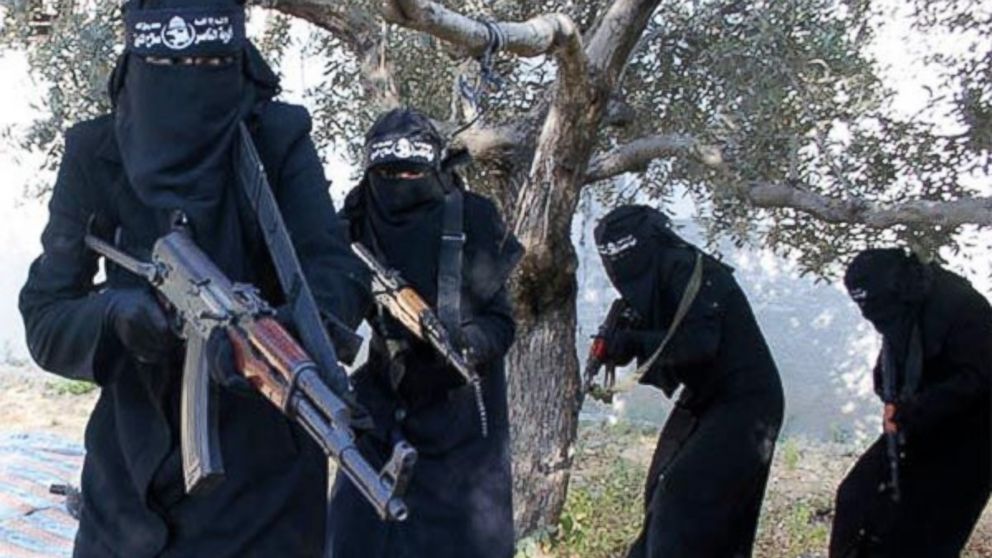
The male patriarchy in the Middle East is a concept that remains somewhat the same throughout time, while still varying in its degrees of stringency. If ISIS is successful in its overall mission, the strictest policies on gender separation will become law. That’s where the al-Khansaa women’s brigade of ISIS comes in. Considering strict religious rules regarding contact between men and women, the women of ISIS have been employed in keeping the women of conquered land in alignment with Sharia law. This brigade was established in Raqqa, Syria shortly after ISIS took control there in August of 2014. Essentially, they are a morality police force that patrols around looking for women who are not dressed or self conducted properly. Sometimes random women will be confronted by a member of the brigade in order to test them on their knowledge of Sharia law. They themselves conform to the strictest ways of dress, showing no parts of their bodies including their eyes. Not only that, but they are armed. A fully covered, black cloaked group of women armed with rifles can be a pretty intimidating sight. For the women themselves, it can be something extremely empowering. The al-Khansaa brigade can in fact be very aggressive when it comes to carrying out their mission. 


Not every woman that is fighting jihad with ISIS is a member of the al-Khansaa brigade. Many practice their loyalty by means of marrying ISIS fighters, promoting the jihad via social media or participating in the promotion or act of sexual comfort roles. Sites like Twitter and Tumblr have become a way for these female ISIS supporters to document their lives and experiences while recruiting women to join their cause. Some of these marriages have taken the " Islamic form of temporary marriage, mutt'a. Mutt'a marriage refers to an old Shia tradition that labels mutt'a marriage as the alternative to permanent marriage. The practice of mutt'a is derived from the issue of Shia soldiers wanting sexual/romantic comfort when they were far from their homes and families in a way that was still halal and would allow both parties to "work within the confines" of Shia law. The practice of mutt'a marriage has been a point of intense controversy between the Sunni and Shia communities. Understanding the purpose and derivation of mutt'a (or comfort) marriage is important in the process of identifying the hypocrisy of ISIS and effort to justify rape, torture, kidnapping, and human trafficking through the misinterpretation of Islamic scripture, tradition, and law... not to mention the fact that ISIS is a self-proclaimed Sunni group, justifying their violence through a twisted form of old Shia law. Aside from making sure that all women keep in line with Sharia law, the women in ISIS also provide the men with the opportunity to reproduce more future ISIS fighters. It has also been reported that women who are sympathetic to the struggles of ISIS are volunteering for jihad al-nikah, or sexual jihad, with ISIS fighters. “Females from Britain, Australia, and Malaysia are among the hundreds of comfort women in Syria and Iraq;” this highlights the international reach that ISIS has. 

Social Media for recruitment and promotional purposes
Although ISIS began as an exclusively male jihadist group, they now encourage and recruit women to promote and enforce Sharia Law. "We have established the brigade to raise awareness of our religion among women, and to punish women who do not abide by the law," Abu Ahmad, an ISIS official in Raqqa, told Syria Deeply’s Ahmad al-Bahri. Women were originally recruited to check women at checkpoints to verify the womanhood of each traveller. However, their role now extends to upholding Sharia law in the cases of women and children. They call themselves the al-Khansaa’ Brigade and are based in Raqqa. Zainab, a Syrian teenager, was arrested by the al-Khansaa' Brigade and describes her experience. "The brigade has created fear among the women and girls of Raqqa," Zainab says. "We've seen how they move, always watching women on the street, raiding schools, arresting students and locking them in for hours." Al-Khansaa’ patrols Raqqa and frequently arrests women under the strict mandates of Sharia law (being fully covered and being accompanied by a male chaperone). What started as a slight inclusion of women into the jihadi subculture has morphed into a female emancipation movement (although limited and oftentimes at the expense of other women). Women have a more active role now than they did in earlier jihadi history from spreading propaganda online to recruiting women to join them to upholding Sharia law.  Thousands of women not affiliated with ISIS have taken to social media (on sites like Twitter and Tumblr) to support ISIS and al-Khansaa.’ While still playing a miniscule role in the ISIS’ objectives, women are now increasing their involvement and changing the landscape of what it means to be a female in a jihadist state.

The armed women of ISIS
Many people around the world have been shocked by the realization that many women in ISIS joined the organization willingly. Firstly, it is known that ISIS initially excluded women from the organization, only allowing them to join after recognition that they would be needed to universally enforce Sharia law. Secondly, there is no doubt that ISIS operates under iron-clad patriarchal and paternalistic authority. Veryan Khan, a representative of TRAC, is quoted in a CNN article stating that “[although the women] have same goals and ambitions as the men once they get there… their roles may be much more limited to a 1950's housewife role”, highlighting ISIS’s oppressive approach to women. Nevertheless, women around the world continue to join and support ISIS, specifically through social media. The issue is identity politics. ISIS is specifically targeting women who feel suppressed by Sunni culture. Ultimately, ISIS provides some of its women with important roles (via women’s brigade or comfort roles, or the prestige of marrying a “war hero”). Al-Khansaa is a women’s brigade that provides the members with a monthly salary and heightened sense of importance and status. However oppressive the organization may be, these social amenities have been enticing and effective for women around the world. One of the main roles of women in ISIS is to recruit women from around the world via social media, specifically Twitter and Tumblr. Some girls provide forums in which they answer the questions of their followers about life with ISIS. This expands beyond the issue of identity within the Middle East. Women around the world who may be sympathetic to the struggles of ISIS, and also feeling oppressed by their own governments or cultures, now have access to information and direct communication with ISIS members.

Many interesting examples of women in ISIS on social media in this Buzzfeed article!
Taken from Buzzfeed article


While ISIS has been giving women a series of “responsibilities” within their organization, its interactions with women outside of its reach, in both Syria and Iraq, have been horrific. Its depredations in Iraq have reached “industrial levels”, according to UN sources. Some 1500 men, women and children have been sold into sexual slavery. Rape and forced marriages are extreme in their contradiction of the stated aims of the Al-Khansaa brigade as an arbiter on moral values, but there may be a brutal logic at play behind ISIS’s actions. Many of the rapes committed against minority groups such as Christians or Zoroastrian Yazidis; this could be seen as part of ISIS’s overall strategy of cleansing of non-Sunni orthodox groups. By not only killing the men but enslaving the women, ISIS ensures that whole communities will be destroyed forever. Sexual violence is also an effective tool for intimidation, a way of enforcing obedience in areas only recently conquered. Many of the victims of the sexual violence, kidnappings, and forced marriages also happen to be under the age of 18. Not only do these crimes against women enforce obedience, but they also ensure, to an extent, that the young girls are easier to control and influence for the cause. Rape, sexual violence, sexual slavery and many of the other crimes committed against women by ISIS violate some of the most basic human rights, but inflicting this terror upon children illuminates the need for attention, and intervention, from the international community. Overall, the relationship between ISIS and women is both complicated and cruel. Women flock to join their ranks from non-affiliated countries, recruited via social media and dreaming of marrying jihadis. The women of the Al-Khansaa brigade gain power and status for themselves by policing the morals of other women, even as women in minority communities are captured and sold into sexual slavery. Though many of the active women members of ISIS believe that they are fighting on the side of feminism, their idea of feminism is non-inclusive, involves the annihilation of alternative social groups, and operates solely on the back of one of the most destructive patriarchy.
Taken from Pro - ISIS Tumblr account

Works Cited

@UmmAnwar6, Umm Anwar Bint Ali. from Twitter Web Site: https://twitter.com/UmmAnwar6

#Al-Khansaa, Al-Khansaa Tumblr. from Tumblr Web Site: http://al-khanssa.tumblr.com/

Al-Qaeda In Syria Forms Female Brigades. (2014, February 2). Al Arabiya News. Retrieved October 5, 2014, from http://english.alarabiya.net/en/News/middle-east/2014/02/02/Syria-jihadist-group-ISIS-forms-women-only-battalions.html

Al-bahri, A. (2014, July 20). All-Female ISIS Brigade Cracks Down on Women in Raqqa. ABC News. Retrieved October 5, 2014, from http://abcnews.go.com/International/female-isis-brigade-cracks-women-raqqa/story?id=24622389

Begikhani, N (2014, September, 23). Sexual violence as a war strategy in Iraq. from Your Middle East Web Site: http://www.yourmiddleeast.com/columns/article/sexual-violence-as-a-war-strategy-in-iraq_25812

Chastain, M (2014, September, 6). The Women of ISIS. from Breitbart Web Site: http://www.breitbart.com/BigThe-Women-in-ISIS-Peace/2014/09/06/

Chastain, M (2014, August, 27). Women Volunteer for Sexual Jihad with Islamic State. from Breitbart Web Site: http://www.breitbart.com/Big-Peace/2014/08/27/Women-Volunteer-for-Sexual-Jihad-with-Islamic-State

Esfandiari, H. (2014, September 2). ISIS’s Cruelty Toward Women Gets Scant Attention. The Wall Street Journal. Retrieved October 6, 2014.

Fadel, L (2014, October, 3). ISIS Captives Tell of Rapes and Beatings, Plead for Help. from NPR Web Site: http://www.npr.org/blogs/parallels/2014/10/03/352815113/isis-captives-tell-of-rapes-and-beatings-plead-for-help

Gilsinan, K. (2014, July 25). The ISIS Crackdown on Women, by Women. The Atlantic. Retrieved October 4, 2014, from http://www.theatlantic.com/international/archive/2014/07/the-women-of-isis/375047/

Gowrinathan, N. (2014, August 24). The Women of ISIS. Global. Retrieved October 5, 2014, from http://www.foreignaffairs.com/articles/141926/nimmi-gowrinathan/the-women-of-isis

Hall, E (2014, September, 11). Inside the Chilling Online World of the Women of ISIS. from Buzzfeed Web Site: http://www.buzzfeed.com/ellievhall/inside-the-online-world-of-the-women-of-isis#2p31jh7

Leigh, K (2014, August, 27). Tabqa Victory Consolidates ISIS Control Around Raqqa - But Urban Showdown Still to Come. from Syria Deeply Web Site: http://www.syriadeeply.org/articles/2014/08/6012/tabqa-victory-consolidates-isis-control-raqqa-urban-showdown/

Peretz, A., & Maller, T. (2014, September 16). The Islamic State of Sexual Violence. Foreign Policy. Retrieved October 4, 2014. Web Site: http://www.foreignpolicy.com/articles/2014/09/16/the_islamic_state_of_sexual_violence_women_rape_iraq_syria


Reporter, M. (2014, September 10). American teen wears hijab in court as she pleads guilty to charges she tried to join ISIS in Syria. Mail Online. Retrieved October 5, 2014, from http://www.dailymail.co.uk/news/article-2750264/Colorado-woman-set-plead-guilty-terror-case.html

Shubert, A & Naik, B. (2014, September, 10). From Food Recipes to AK-47s: Inside Online World of the Women of ISIS. from CNN World Web Site: http://www.cnn.com/2014/09/10/world/meast/iraq-syria-isis-women/

Sherwood, H., Leville, S., Willsher, K., Knight, B., French, M., & Gambino, L. (2014, September 29). Schoolgirl jihadis: the female Islamists leaving home to join Isis fighters. The Guardian. Retrieved October 5, 2014, from http://www.theguardian.com/world/2014/sep/29/schoolgirl-jihadis-female-islamists-leaving-home-join-isis-iraq-syria

SRSG Bangura and SRSG Mladenov gravely concerned by reports of sexual violence against internally displaced persons.   2014, August, 13). from United Nations Iraq Web Site: http://www.uniraq.org/index.php?option=com_k2&view=item&id=2373:srsg-bangura-and-srsg-mladenov-gravely-concerned-by-reports-of-sexual-violence-against-internally-displaced-persons&Itemid=605&lang=en


TRAC: Terrorism Research & Analysis Consortium Web Site: http://www.trackingterrorism.org/


UN Human Rights Chief Zeid condemns ISIL killings of women politicians and activists in Iraq. (2014, September, 26).   from United Nations Iraq Web Site: http://www.uniraq.org/index.php?option=com_k2&view=item&id=2681:un-human-rights-chief-zeid-condemns-isil-killings-of-women-politicians-and-activists-in-iraq&Itemid=605&lang=en